
What is an
Anterior Cervical Discectomy with Fusion (ACDF)?
Learn how an ACDF can reduce neck pain.
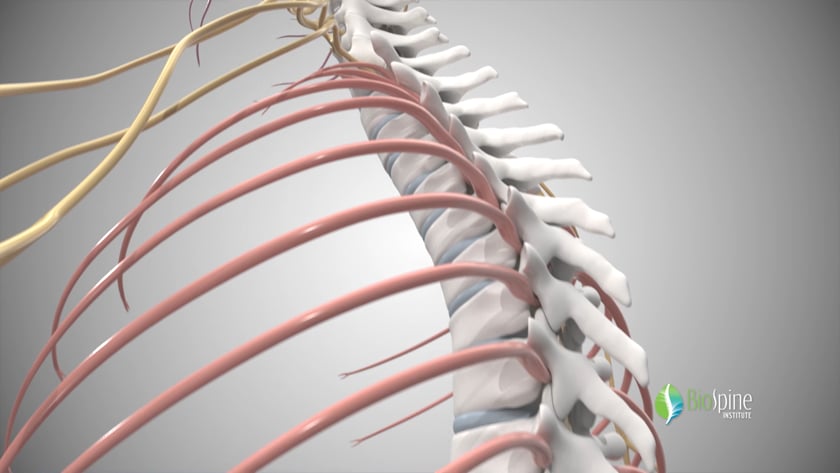

Let's start by talking about what might be happening with the spine and causing the symptoms you're experiencing such as pain, tingling, and numbness. First, we have the spinal cord, which comes from the brainstem and descends down the cervical spine into the middle back and then low back. Along with the spinal cord is a connected link of 33 vertebrae. The cervical spine is made up of seven vertebrae, the lumbar spine is made up of five vertebrae. Within this chain of vertebrae is a small canal, the spinal canal. It is through this canal that the spinal cord and two pairs of nerves and are directly from the brain stem and continue down the back finally exiting the vertebrae before continuing into the legs. Each vertebrae is made up of several parts. There's the vertebral body which is made of solid bone and provides the main support for the spinal column. Each side with lots of attached to muscles and ligaments is called the transverse process. On the back is the spinal process which protects the spinal canal. Between each vertebral body is a disk that acts as a shock absorber. Each vertebrae is connected to the next at a facet joint which is what allows the spine to move. However, those shock absorbing disks can get damaged. Often damage can be caused by a trauma such as a sports injury or car accident. But even without trauma, over time, the disks can start wearing away due to the effects of gravity and normal wear and tear from everyday activities. For posture, repetitive motions can increase the speed of wearing and cause a disk to rupture or herniate. This rupturing is often referred to as a slipped disk. Parts of the disk can travel down into the spinal canals putting pressure on the nerves which then cause pain and weakness in the legs. Arthritic conditions can wear joint surfaces as well as causing destruction at the joints and shifting of the vertebral body alignment further damaging nerves. These changes can lead our surgeons to recommend what is known as a cervical fusion or an ACDF which stands for anterior cervical disk fusion. [MUSIC PLAYING]


In an ACDF, the doctor actually removes the problem disc, relieving the surrounding nerves of all the pressure that disc was creating. However, when a disc is removed, the vertebrae above and below lose a certain amount of stability. The doctor will add a spacer and a plate where the disc used to be in order to recreate the proper support. The spacer contains synthetic bone graft. And over time, that bone graft will expand appropriately, providing complete support. The small plate is held in place with tiny screws. This provides strength while maintaining the proper space between the two vertebrae, while the bone grows. Something interesting to note is that an ACDF is actually performed through the front of the neck. Now, some of you may be thinking. Front of the neck, is that safe? Why not just go through the back of the neck? Contrary to some beliefs, it is much safer to perform the procedure through the front of the neck. The front approach offers the least amount of tissue damage and blood loss, which is the safest for the patient. And because the doctor makes the incision in one of the natural folds of the neck. It means the scar will be nearly invisible. [MUSIC PLAYING]
3D images simulate the procedure and elements may differ in color, texture and placement than an actual surgical procedure.

PROCEDURE LENGTH
45 - 60 minutes


INCISION SIZE
¾” to 1”

NO HOSPITAL STAY
Outpatient procedure
The vast majority of procedures at the BioSpine Institute are performed through a ¾” incision; however, there are a limited number of procedures that may require a slightly larger incision.
What Is an Anterior Cervical Discectomy with Fusion (ACDF)?
An anterior cervical discectomy with fusion (ACDF) is a procedure designed to remove herniated disc material in the cervical spine. In the case of a cervical injury, the surgeon reaches the damaged disc from the front of the spine through the neck.
After the disc is removed, a space between the vertebrae is empty. The pressure is released from the pinched nerve roots, and the pain is relieved. To prevent the vertebrae from collapsing and rubbing together the surgeon fills the open disc space with a spacer, and they are stabilized with a plate to allow bone growth and a solid fusion. The two vertebrae form one solid piece of bone in 3 to 6 months.


The majority of patients will notice immediate improvement of some or all of their symptoms while other symptoms may improve more gradually
Am I a Good Candidate for Cervical Fusion?
You may be a good candidate for an ACDF if you experience severe neck pain, weakness, or numbness that prevents you from participating in normal daily activity. If your neck symptoms do not improve after four weeks of non-surgical treatments, or a physical examination shows you have motion loss, abnormal feeling, or weakness that will likely improve with surgery, anterior cervical discectomy with fusion may be an option.
Used To Treat These Conditions

A herniated disc is a spine condition where the gel-like material in the disc leaks out. It is also referred to as a slipped disc or a ruptured disc.


Spinal stenosis is the narrowing of the spaces in the spine, which puts pressure on the spinal cord and nerves.

Instability
How Will I Feel After Surgery?
The majority of patients will notice immediate improvement of some or all of their symptoms while other symptoms may improve more gradually. A positive attitude and following your doctor’s post-surgery instructions will contribute to a satisfactory outcome.
*The Anterior Cervical Discectomy with Fusion (ACDF) procedure is recognized by the American Medical Association.


